Friday, January 27, 2017
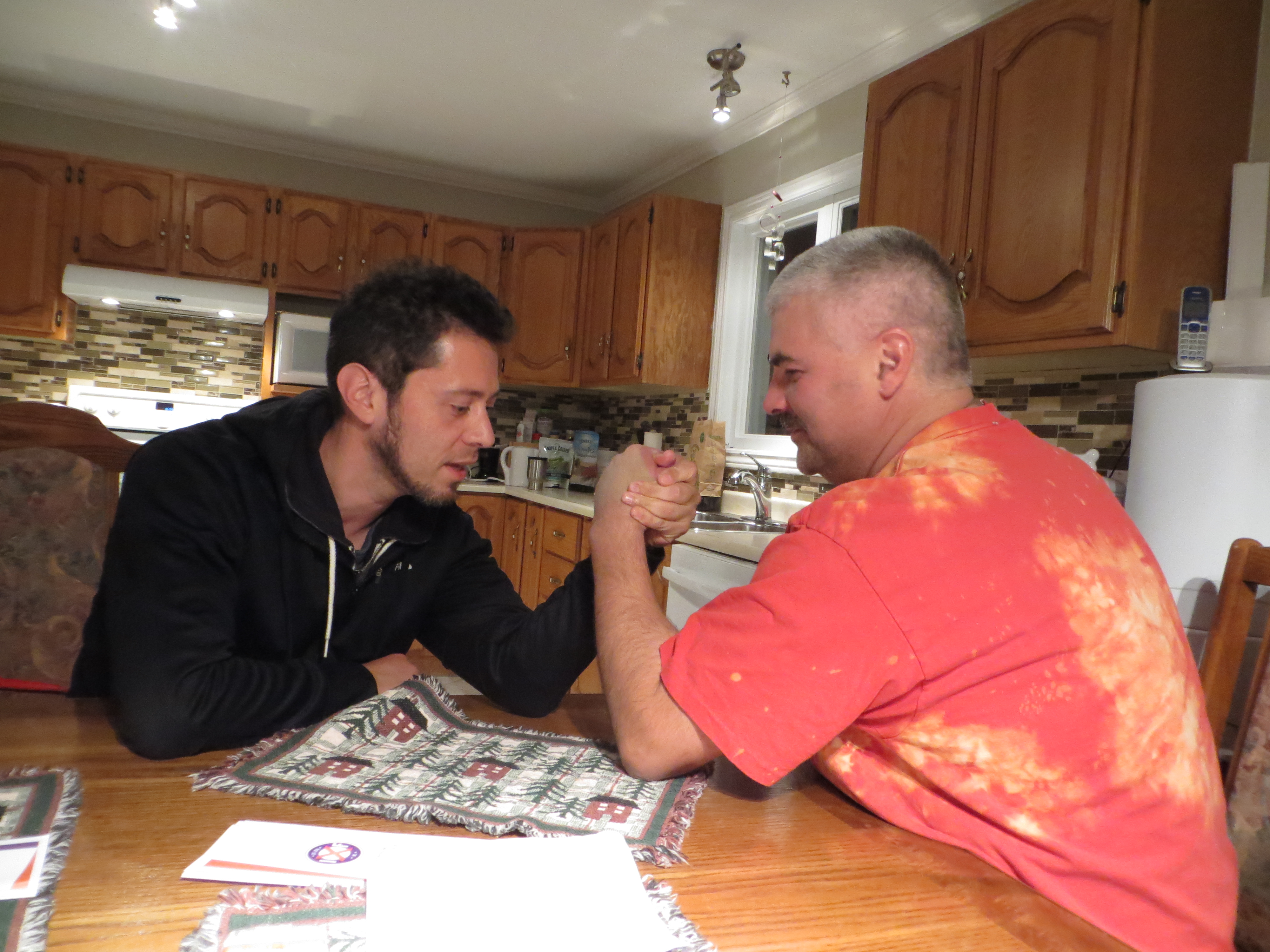
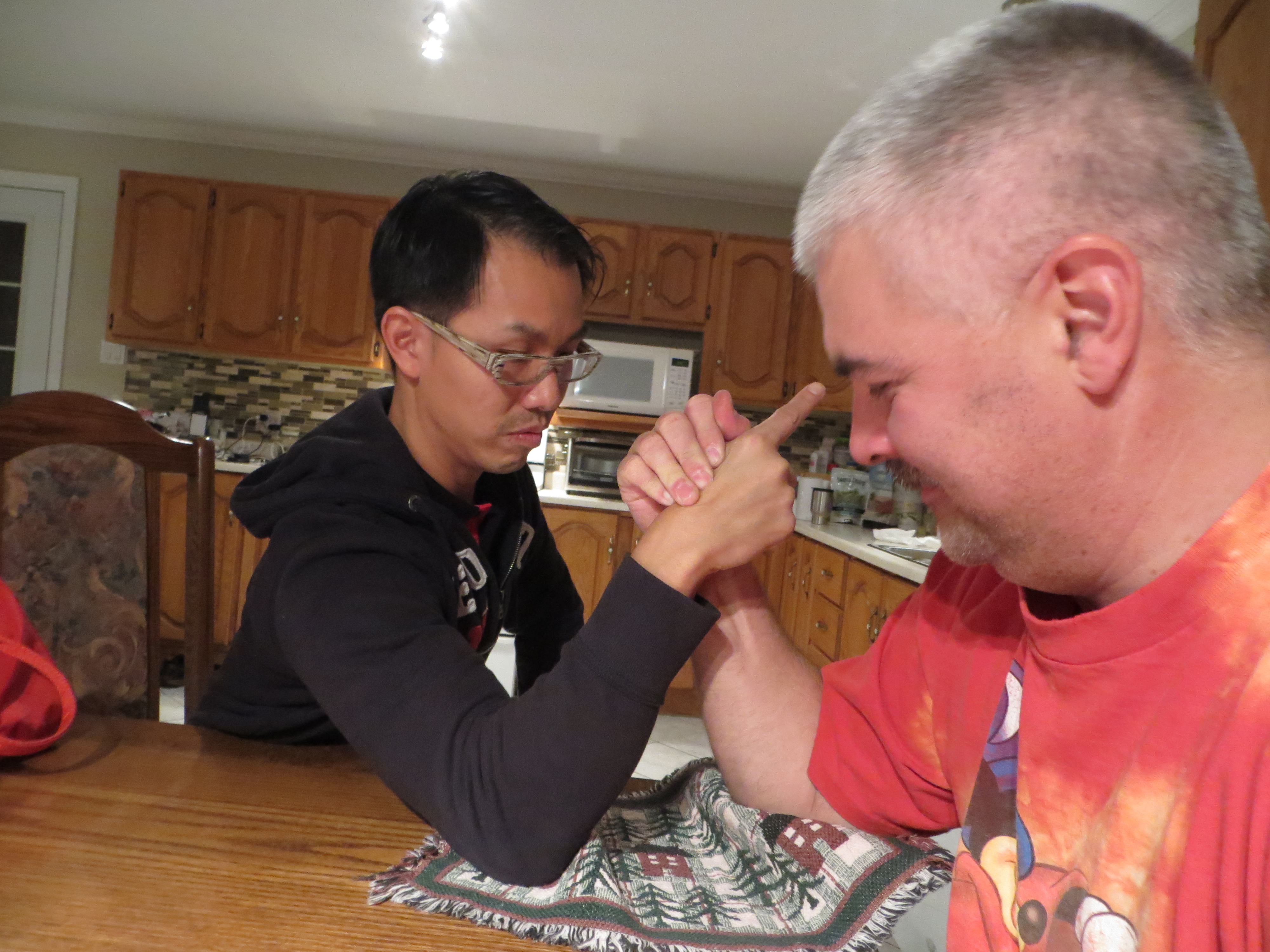
Brennan Toh's review on pushing hands with Kelvin Ho
Kelvin has gotten a lot stronger. Recently (past year?) he's gotten stronger than me, more clearly able to define a set line and consistently move along that line. Structure is more self contained, much less reliant on the opponent. Starting to feel a lot more like Chen Xu with a defined pole as centre. Good understanding of when the other person has over extended or is light on their front foot (quick switching move). Improvement at taking up space on the bottom by putting pressure on with the knees, also preventing opponent from moving their feet.
Still lots of downward application of force, but rather than hanging off the other person as he used to it is now more relevant to keeping them locked and allowing him freedom of movement. Lacks mobility in feet (still primarily uses open stance), might be unable to move feet. Vulnerable to feints as he reacts very quickly to each movement (able to differentiate between empty and dangerous moves?). Better at sustaining single lines, but dependent on that line overpowering to prevent the opponent from holding that line while finding others.


Wednesday, January 4, 2017
Morning practice - Don't skip it
It is important for me to have a morning taiji practice session. I practice a certain number of yilus, they count towards a goal that I set. The latest goal is 50,000 yilus. Getting a few yilus done in the morning (currently 5) though is only 0.5% towards the goal, it is quantifiable and real. It gives me a sense of accomplishment right at the beginning of each day, and equips me to face the challenges for the rest of the day. This is a reminder for me not to skip the morning practice.
Saturday, December 31, 2016
S-curve is really the circle

In taijiquan, we often hear people refer to a circle, drawing a circle, or being rounded. The essence of a circle is rotation. It is by rotation that a dot on the surface of any object can draw a circle. A sphere or ball is the 3D extension of a circle. A circle also has the characteristic of a loop, where there is no beginning or end, in the other words, anywhere can be the beginning which can then be the end. To complete a rotation, there is a one-way path from beginning to end, and there is no going backwards on the same path, otherwise, it is equivalent to nothing happens at all.
Due to the way a human is built, we cannot perform a true rotation. What can be achieved is an approximation of it, and we can perform a portion of a rotation at a time. In order to perform a full rotation, switching is required. Switching can refer to switching of pivots (non-moving parts) or switching of moving parts.
In Figure 1, line AB rotates around point B to become line CB. Line CB moves laterally to become line YC. Y becomes the new fixed point. Line CY rotates around Y to become ZY. This represents a full rotation by having two action halves. This is the S-curve often referred by Master Chen Zhonghua. It marks the way in which the human body performs a circle. Note that this is also the taiji symbol.
Figure 2 is similar to Figure 1 except no lateral move, and there is a direct switching from point B to point Y as the non-moving point.
Figure 3 also represents a full rotation, although it may not look like one at first glance. There are two halves. In this case, the circle is smaller, and in fact, it is more like an ellipse.
Figure 4 represents a full rotation that is further broken down. Switching of pivots is depicted here (points B,C,D,E,V,W,X,Y). For simplicity of the drawing, 8 equal pieces are used, however in reality, they do not need to be equal in size. The overall shape is also asymmetric. This is a 2D representation. Imagine how crooked it will look if the pivots are not located on the same plane.
In order for each portion of a rotation to continue from the last one, what is gained in each portion must be maintained/kept, so that position becomes the starting point of the next one. Let’s take the right-side positive circle in Practical Method as an example. In the most basic version, we do a 3-count circle:
- In with elbow
- Turn with waist
- Out with hand
After the first count, the elbow must touch the side-ribs. In the 2nd count, while the elbow is touching the ribs, pushing the right foot to the ground and rotating the right kua with the left kua being the pivot cause the waist to turn to the left. This is the first half of the circle. For the 3rd count, using the right kua as the pivot, pushing the left foot to the ground and rotating the left kua causes the right hand to go out as part of the geared action. This completes the 2nd half of the circle. Note that the waist turn is only going to the left in one direction throughout the entire circle. There is no reset.
Let’s look at only the relationship between the elbow and the hand. The in-with-elbow-no-hand is the first half of a circle, and the out-with-hand-no-elbow is the 2nd half of a circle. This is an example of switching of moving parts. After the in-with-elbow-no-hand, the elbow continues to go inwards (no loss of compression towards the dantien) while the out-with-hand-no-elbow takes place maintaining the tension between hand and elbow.
The four figures above show different representations of the S-curve that involve physical actions. Master Chen has also shown before that having a particular physical shape in the body with various stretches can allow energy to travel in a rotating fashion without any obvious external movements. That is another topic for the future. At the mean time, keep practicing.
The four figures above show different representations of the S-curve that involve physical actions. Master Chen has also shown before that having a particular physical shape in the body with various stretches can allow energy to travel in a rotating fashion without any obvious external movements. That is another topic for the future. At the mean time, keep practicing.
Wednesday, December 28, 2016
What's the difference between Practical Method and other taijiquan or martial art? 实用拳法和其它拳的差别
http://v.youku.com/v_show/id_XNjkwODU2OTE2.html
Notes:
笔记:
Notes:
- Master Chen when answering the question focused on Practical Method itself, and left it to the audience to do the comparison, as he couldn't represent the other art.
- Practical Method's core is rotation. Spiral and silk reeling is rotation plus distance.
- We can never do true rotation. It's impossible for us to do 360 degree rotation. We can perform a lever action. A lever action is a part of a rotation.
- Form training is to create levers in our bodies.
- Grandmaster Hong Junsheng has the 10-word saying "Out with hand no elbow, in with elbow no hand". Lin Ketong calls it 10-word mantra.
- This mantra actually describes the lever action.
笔记:
- 陈中华老师解释了实用拳法的特点,跟其它拳种的比较留待观众自己作出。陈中华老师不能代表其它拳种说话。
- 实用拳法的核心东西是旋转。螺旋缠丝是旋转加距离。
- 我们不可能做真正的旋转,360度是不可能的。能做的是杠杆。杠杆是旋转的一部分。
- 套路练的是杠杆。
- 洪均生老师的十字诀是出手不出肘,收肘不收手。林克彤叫它十字真言。
- 十字诀就是形容杠杆的。
Thursday, November 24, 2016
It's not the same
Today, in my Angus Glen taiji class, I received a comment from the student indicating that what I taught was the same as what I was just demonstrating the way I practiced. The comment was primarily based on the look of the form. I was doing a much lower stance compared to theirs. I went on to explain that as one progressed one would need to keep challenging one's limit. Going low in the stance was one of the methods. It trained the leg strength, it allowed one to discover structure alignment, it locked up the body so one can train moving the parts one can't move before.
This incident reminded me of a story told by Master Chen Zhonghua that one of his students, now disciple, asked to learn the form he first saw meeting Master Chen. Master Chen's response was that he had been teaching the student that form, which was yilu all along, but in the student's mind, he was not the same.
This incident reminded me of a story told by Master Chen Zhonghua that one of his students, now disciple, asked to learn the form he first saw meeting Master Chen. Master Chen's response was that he had been teaching the student that form, which was yilu all along, but in the student's mind, he was not the same.
Sunday, November 13, 2016
Notes for Practical Method Ottawa Workshop Nov. 12-13, 2016
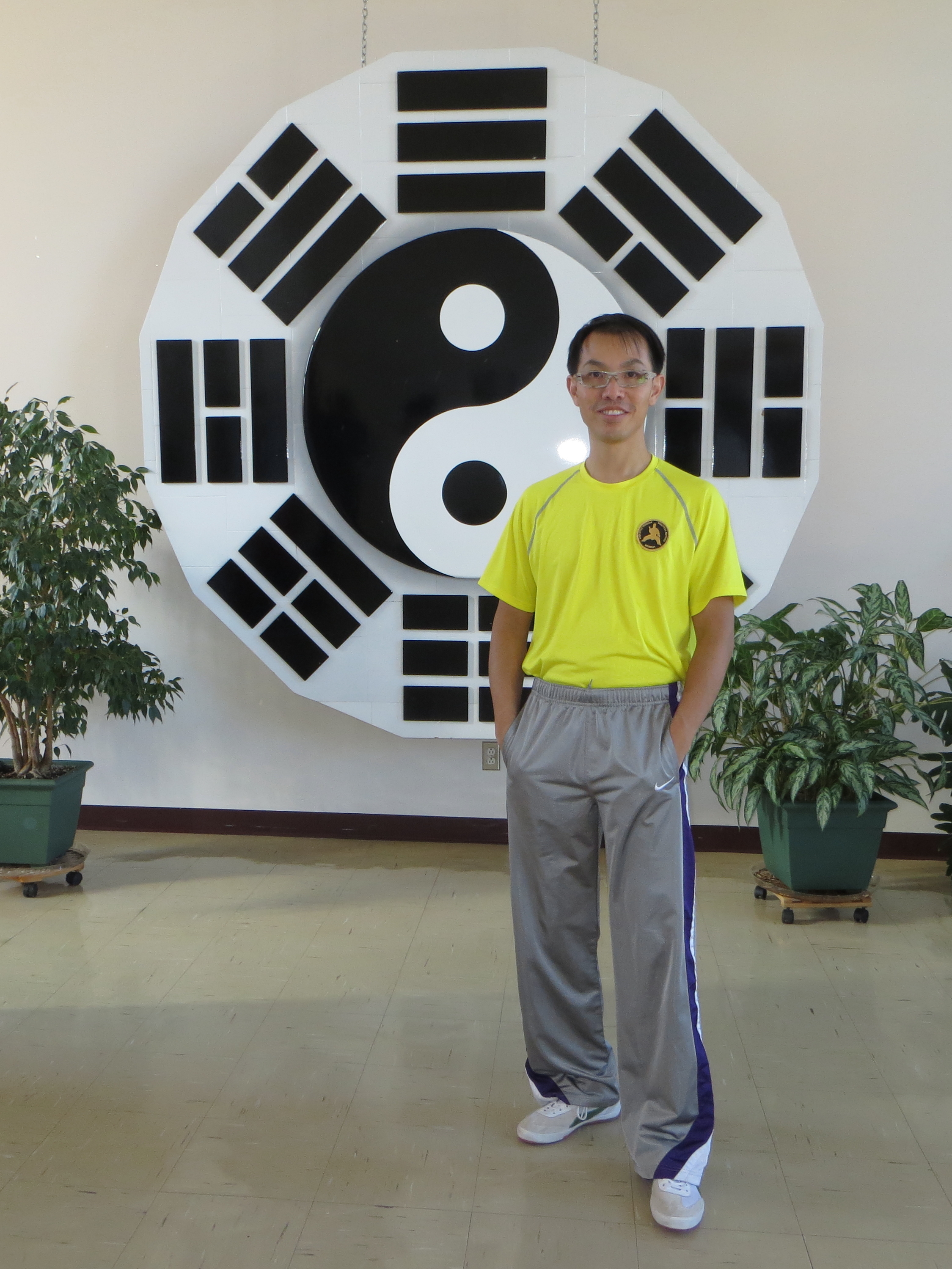
- Move the feet. When we train, we fix the feet. When you push hands, we move the feet. Our feet are often not mobile enough, we must force ourselves to move them, e.g. getting in changes the pivot.
- The only way to connect is not to connect. Connection means moving and non-moving parts have a relationship.
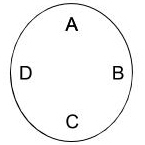
- We need to resolve change without change. When A moves to B or B moves to C due to a rotation of the circle, there is really no change from taiji's perspective.
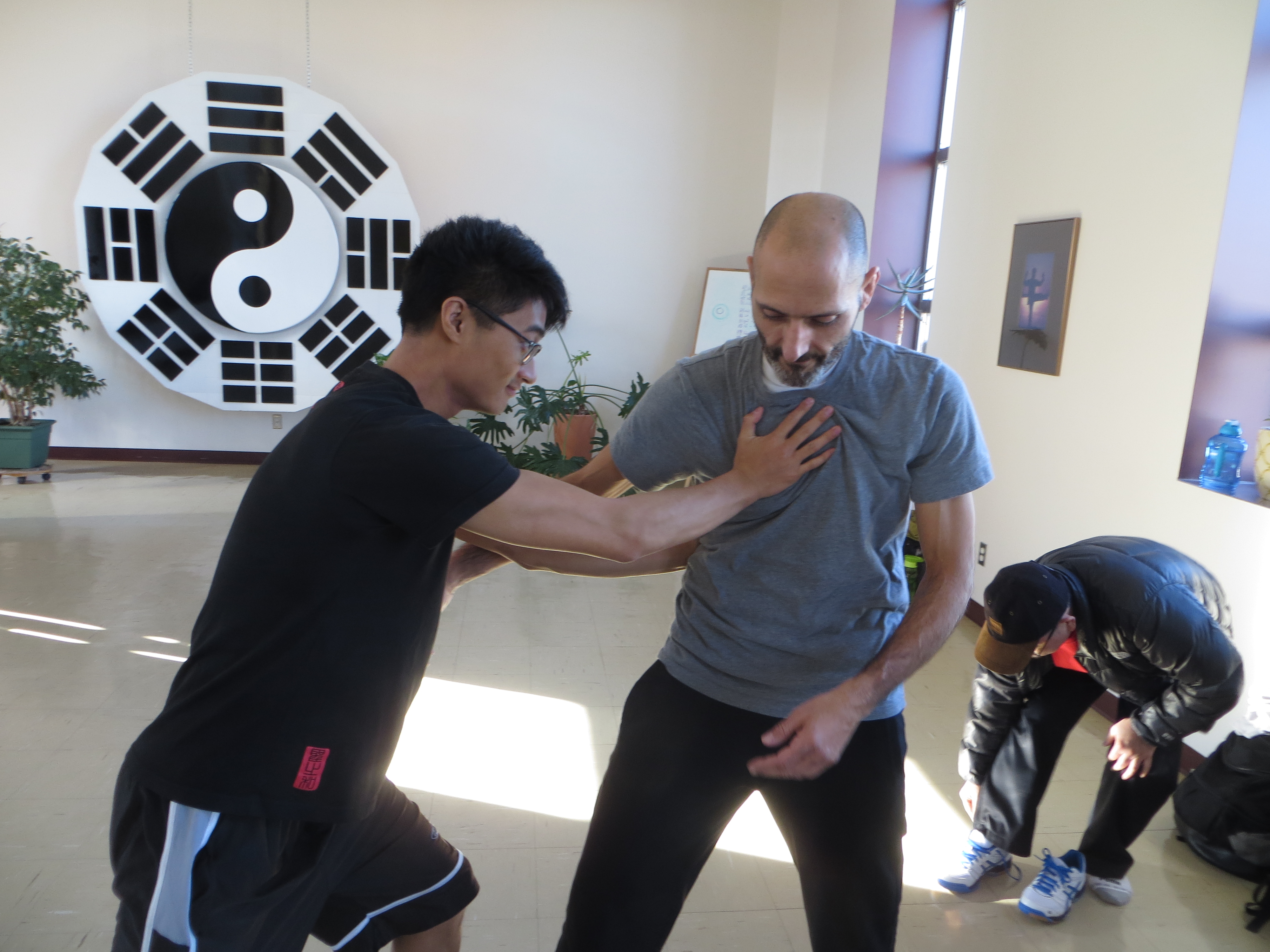
- Twisting the towel, both hands are on the same line, palm faces down close to the body, palm faces up when the arm is extended. Line up the two dots (front hand and rear elbow). My eyes were not right, I couldn't line up the two dots.
- Learning must be direct, progress must be indirect.
- In with elbow, turn with waist. I am not starting the waist turn with the kua.
- Instructions must be obeyed.
- Every person has restrictions put on him by himself.
- Push hands: don't let you opponent test you. When the opponent charges, you must charge as well, never back off.
- Exercises:
1) You grab the opponent by the wrist, the opponent tries to shake it off by going up and down. In order to not getting shaken off and not let the shoulder take all the force, you need to resolve the shaking by stretching the rear kua.
2) You grab the opponent by the wrist, the opponent tries to move the hand back and forth. You must stay with the opponent.
3) You grab the opponent by the wrist, the opponent walks back and forth. You must stay with the opponent. - Saying: Stick to your opponent and die together, who does not want to die will get out.
- As you create space, you must fill it immediately.
- Don't push your opponent, pushing is a release and creates space.
- Rear foot to front kua is a stick that keeps poking into the opponent.
- Don't let your opponent fight the battle on your turf. Invade your opponent's homeland - Go over.
- Relate two dots with a non-moving third dot.
- 挨着哪儿哪儿打 - Wherever that is touched, that's where is used to hit
全身不处不是拳 - Any body part can be used as the fist (Literal translation: No body part is not the fist) - Switching - Use your hand to make your opponent feel strong, once engaged, switch to use power somewhere else.
Exercise: You had an arm bar on the opponent, your front foot is in front of the opponent's front foot. Once engaged, switch to a different pivot, and stretch your front foot back under the opponent's leg. At the end, step on the heel. Before stepping on the heel, all space must be taken out. - Tension and compression are the same, but the difference is in the perspective. Tension is going away from the non-moving point, while the compression is going towards the non-moving point on the same line.
- Fetch water - lock front knee or front hand, front shoulder down to find the front kua coming up.
- Converting the vertical to horizontal: Compress the front shoulder to front kua, and then rotate the waist from front kua to rear kua (this elongates the horizontal)
- Converting horizontal to vertical: Opponent comes in and pushes into the abdomen, compressing the opponent's elbow into his hand (which touches your abdomen), the stretch vertically to the head.
- 50,000 yilus is the new goal given to me. Go make the actions automatic for me.
- Gong vs Fa: Gong is the principle expressed in the action. Fa is the ability to do a technique. An old master has gong but not necessarily fa anymore. It is like a short blade knife. If you are stabbed with it, you will feel hurt, but you won't die. An old master can let the student feel the principle, and that's why he can still teach.
- Go voluntarily to where your opponent want you to go, and at the end add something to it.
- Shifu adjusted my fetch water, the rear shoulder needed to be much higher than I expected to line up with my front hand. He made me realize that once the front hand and the rear shoulder line up, there was power. Of course, the rear cannot be floating.
- Shifu asked me to train flexibility, move anything else except the dantian by stretching, especially move the feet. When someone pushes me, move some body part (do something) away from the contact point to buffer it. Keep the power constant like I am in the elbow in position.
- Keep the elbow in, and yet stretch the hand towards the opponent's centre.
Sunday, October 23, 2016
Reaching 20,000 yilus
On Oct. 23 , 2016, I reach 20,000 yilus. From 19,000 yilus to 20,000 yilus, I have noticed the following:
- I am moving less of my hands, and using the rotation on the joints to propel the movements. This allows me to engage my waist more.
- The triangle formed by the two kuas and dantien is becoming more prominent during the form. I think that this helps the engagement of the core in all actions.
- I am able to locate my students' centres faster during demos, but not fast enough during push hands.
- During push hands, I need to get my opponent to commit to his actions, then I find the lines more solid and maintainable.
- My stance when doing the form is now lower than before. This seems to allow me to stretch out the kuas more. However, I also notice I sweat a lot more than before doing just a couple of yilus, and I need to take a break. I am only doing 5 yilus a day right now, and I already feel very tired at night.
Subscribe to:
Posts (Atom)