What does it mean by lining up the forearm and rear calf? There are 2 ways:
- The forearm and rear calf can on the same line, but separate into two sections.
- The forearm and rear calf can also be on two parallel tracks.
What does it mean by lining up the forearm and rear calf? There are 2 ways:
Overall, flash the back is used to throw someone over the top. We started training with a stick to understand the idea of a lever. The left hand is a pivot and does not move at all. The right hand holds one end of a stick, it starts at a location front of my body. It stretches against the non-moving left hand, and goes downwards towards the floor, and then goes up on the other side, all the while stretching more. At the same time, the right move from the front to the back, it is used to pull the stick. We have to imagine that the other end of the stick has a heavy load. We catapult the heavy load over our head and throw it. As my right hand stretches down and back, there is a point where the opponent's power disappear, and we need to quick switch to the other side with the left hand continuing the overall vertial rotating motion. The use of the stick makes it very clear how the lever works here.
Now without the stick, we need to rotate the dantian area. We need to thrust the dantian to the left and up to go around the top. The stick is like between the left hand and the right foot. The movement of the right foot allows the left hand to turn over at the dantian.
Today, Master Chen Zhonghua talked about how to cause energy to go around within the forearm. It involved using the shoulder to cause the elbow to go over within a vertical plane of the entire arm. We have done similar exercise for the kua and knee standing on one leg.
The elbow is not allowed to move, but it has to rotate. The elbow rotation is driven by a very big motion at the shoulder.
Chinese Class
In Six Sealing Four Closing, there must be a stick that does not change direction between the two hands. In Practical Method, there are rotation and resolution. Rotation is not considered a move. Resolution is considered a move as it causes something to change position with respective to the ground. The result is 螺旋缠丝 luo xuan chan si.
This is moving a rotating saw to cut a piece of board. As the saw makes contact of the board, the rotation does not slow down, the saw blade does not change shape as someone pushes the saw through the board (or the board through the blade). The common problem is that we change shape or direction as we move
English Class
In training, we must lock the whole body, and move one body part. Use a big stance in Brush Knee in Oblique Stance to lock the body up, and try to only push up the front (left) kua. Only in this kind of training, we can train to gain the power. Most people just train the useless moves, moves that make them feel good. The move we want to train is the one that we don't want to do, and it is one that seems impossible to do.
At the begining of the 2nd Flash the Back, I need to lock the front (right) hand and put the rear (left) shoulder into the same line with the front hand. Lock them, and try to open front (right) kua, lock the front kua, and move the rear (left) kua.
Before the jump after Flash the Back, I need to make the right kua bump into the left kua like newton balls, to cause the jump (no movement in the body).
After Punch Covering Hand, I need to shrink the distance between the right elbow and the right kua, in order to suck the right foot up to complete the turn.
In Single Whip, after the right hand and left foot stretch, I must rotate the left kua to get into the left half horse stance. I can't just move the left kua.
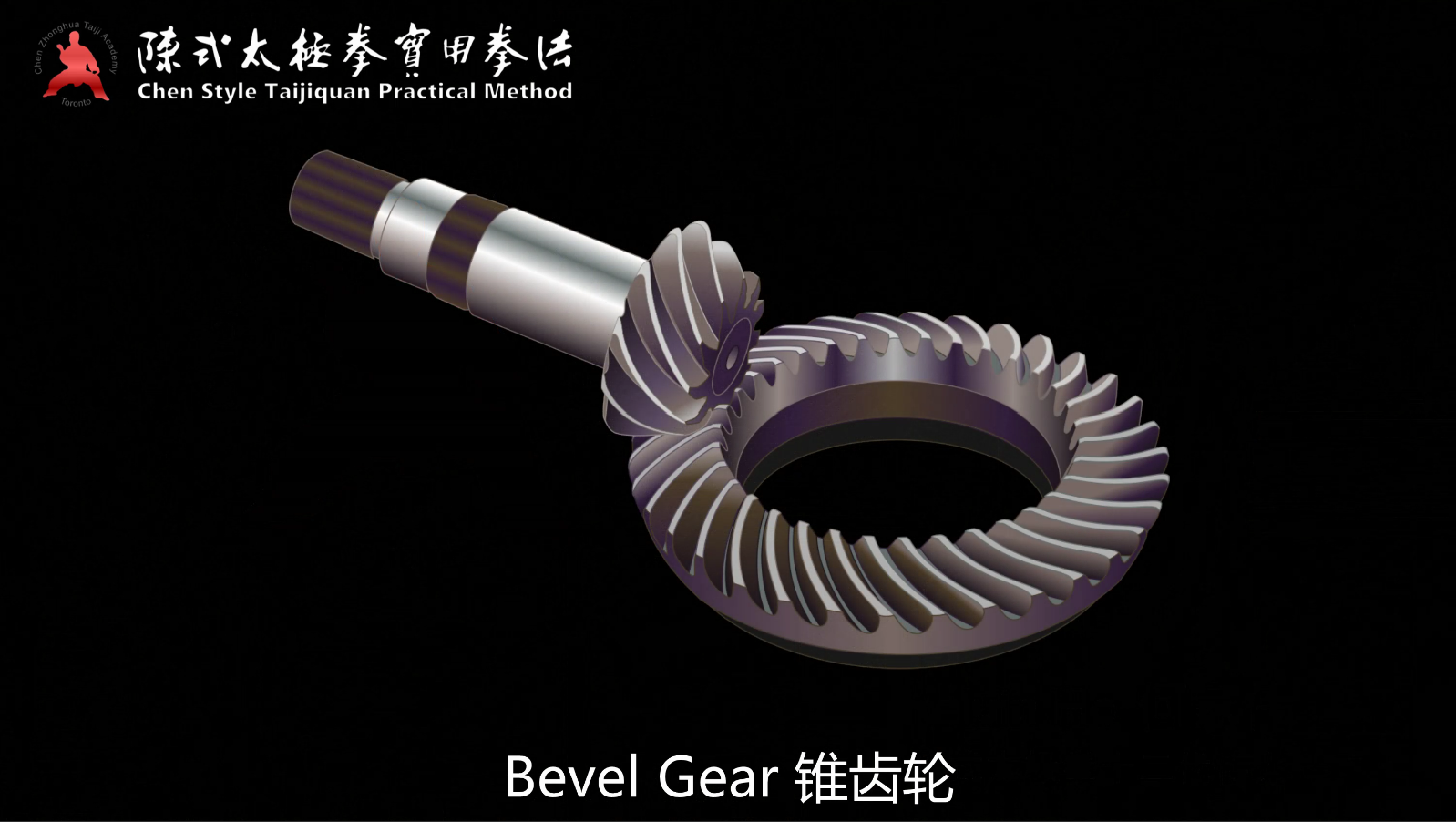 The torso is attached to the arm in the same way as how a bevel gear works as shown in the diagram above. As the torso rotates, the arm must rotate proportionally. This is the result directly related to how it is set up. In action operation, it is key to start the arm rotation from the armpit. Another important part is that the action must be initiated by the kuas, causing the waist (torso) to rotate, in turn, causing the arm to rotate. When the torso must also be like a solid cylinder, when the waist (bottom part) turns, the shoulders/chest (top part) must turn together. This is said to have one action, while two different parts are moving/rotating in their own designated ways. In the future, there can be more than two gear discs attached together, one action drives many different individual movements. In taiji, this is known as when one part moves, all parts move.
The shoulder is where the split happens. It is the middle that is not involved in either side. No power should be added at the shoulder. This allows the dantian and the fist to be connected. The resulting action is called a “through fist/通拳“, it is not a punch in the normal sense.
When observing others performing the same exercise, the following common mistakes are noted:
The torso is attached to the arm in the same way as how a bevel gear works as shown in the diagram above. As the torso rotates, the arm must rotate proportionally. This is the result directly related to how it is set up. In action operation, it is key to start the arm rotation from the armpit. Another important part is that the action must be initiated by the kuas, causing the waist (torso) to rotate, in turn, causing the arm to rotate. When the torso must also be like a solid cylinder, when the waist (bottom part) turns, the shoulders/chest (top part) must turn together. This is said to have one action, while two different parts are moving/rotating in their own designated ways. In the future, there can be more than two gear discs attached together, one action drives many different individual movements. In taiji, this is known as when one part moves, all parts move.
The shoulder is where the split happens. It is the middle that is not involved in either side. No power should be added at the shoulder. This allows the dantian and the fist to be connected. The resulting action is called a “through fist/通拳“, it is not a punch in the normal sense.
When observing others performing the same exercise, the following common mistakes are noted:
Exercise:
Move right kua to the front, left kua to the back.
Move right kua to the back, left kua to the front.
This increases range.
Eventually, the ending diameter needs to be longer than the starting diameter, even though the difference may be very small.
We need to a twist in every part of the body.
Exercise
Six Sealing Four Closing

