Sunday, October 19, 2014

Notes for "What is to get it" Online Video

http://practicalmethod.com/2014/10/what-is-to-get-it-online-video-purchase/

Notes:

  1. Gravity is the natural energy, which means we should strive to confirm our actions to that.  We normally move horizontally which is not conforming, so we get tired.
  2. We are naturally afraid of falling, but animals are not.
  3. We didn't come from earth. We want to go back up to heaven.
  4. We normally use energy that comes from food. We don't tap into our natural energy.
  5. People who meditate eat very little, and don't eat meat. They want to train that natural energy.
  6. Babies hear everything in the womb, but after they are born, they make connections to those sounds. When the connections are made incorrectly, they have trouble when they grow up (mentally). We can live with most of these connections made correctly, and can tolerate not being 100% correct.
  7. You have to trust your teacher. There is a risk, which is what if the teacher doesn't know. Well, since you don't know, you can't really tell if one knows or not. My thought: If you know what you are looking for, you really know already, then you don't need to learn from the teacher.

Practical Method Toronto Pushing Hands Training


Monday, September 22, 2014

Cannon Fist Complete

I started learning cannon fist through the detailed cannon fist instructional video about a year ago, and had been working on it on and off. I probably had watched the moves in the first half of the routine multiple times as I had not been constantly practiced what I learned. Every time I tried to pick it up again, I would watch the video from the beginning again. So I never seemed to be able to finish it. Today, I finally finished learning the cannon fist choreography and completed 9 times of the routine.

Saturday, September 6, 2014

Notes for Bypass Strong Point Online Video

http://practicalmethod.com/2014/09/bypass-strong-point-online-video-trailer/

I have heard phrases like "go around it", "3-way split", "trust the system" multiple times in Master Chen Zhonghua's workshops and videos before, but I am enlightened by this particular video. It is such a gem. No one should miss this.

Notes:

  1. 2:10 - We can understand how a lever works, but to make it work in the body is highly difficult. I have trouble recognizing the lever, needless to say to use it.
  2. 2:30 to 3:35 - Find the strongest point, go around it.
  3. 5:45 - Master Chen Zhonghua talked about that we had to reverse our thinking. He emphasized this over and over in his teachings. The participant was saying that Master Chen controlled the powering point, in contrary, Master Chen moved everything else but the powering point, and that caused the participant to forget about the powering point. Master Chen used the powering point and did not control it. The result might seem to the participant that it was controlled.
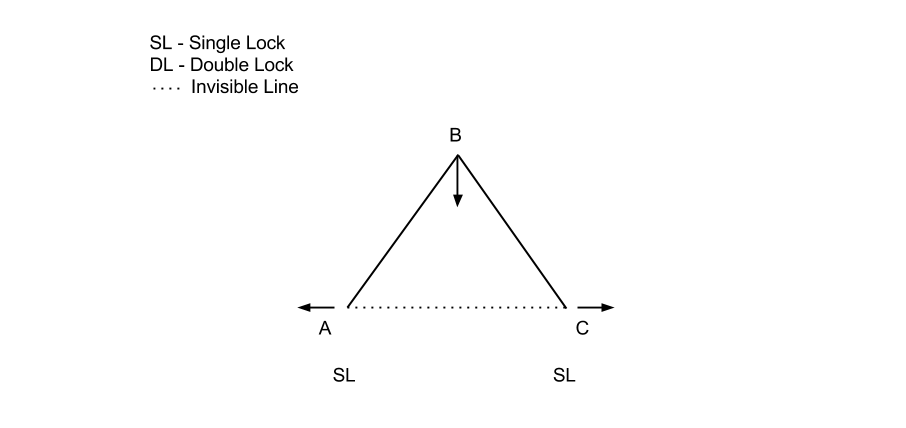
  4. 6:55 to 8:00 - We don't look for the point, we triangulate. I look up what triangulation means, it means if we have one side and two angles for both ends of the line, we can locate the third point of a triangle. Master Chen said he didn't need to look for the (third) point, he just needed to perform the demonstrated action, one point went here, the other point went the opposition direction, the third point had to be there. The fact that people looked for the point, it was the reason taiji was lost. The opponent would not be standing still to let us find the point, something must be done by us to cause the point to appear.
    With the A-B-C triangle in this diagram, A and C are the two points that are being moved in opposite directions along the A-C line, B is located through triangulation because it is connected to both A and C physically. In Master Chen's demo at 6:55, the participant's right hand was point C while the participant's right foot was point A, and point B (the dot) was created somewhere at the participant's waist, and it would come to the A-C line.
  5. 10:15 - We need to trust the system. The form and foundations are the methods. We need to build confidence in the system, such as that we will keep using it and make our actions better and better.
  6. 11:24 - Master Chen drew the above diagram in the air explaining 3-way split.
  7. 11:49 - Each part can only do its designed job. It cannot go into another place. A, B, and C each has its own job.

Monday, September 1, 2014

Notes for Two Lines and Stretch Online Video

http://practicalmethod.com/2014/08/two-lines-and-stretch-online-video-trailer/

Notes:
  1. Develop two different channels/paths for the incoming and outgoing energies. That is separation of yin and yang, which must happen at the same time. It is not yin and yang when you have one path coming in and then one path going out. Two paths must exist at the same time.
  2. The two paths are developed by stretching outside of the arm at a time while keep the inside of the arm fixed, and vice versa.
  3. For a stretch to happen, there must be a fixed point. We first practice by keeping one point fixed, and another point moving. The non-moving and moving parts are yin and yang. We must eventually be able to stretch with any part of the body at any time. At higher level, two points can go in opposite direction on the same line. When you can stretch while your opponent is moving, it is said that you know how to fight.
  4. We don't necessarily need to train every part. Once we truly know how to do it with one part, we will know how to do it for any other part.
  5. Grandmaster Chen Fake used to put his hands inside his sleeves and continuously practice the stretch of the fingers from the elbow. Master Chen Zhonghua demonstrated that when he stretched his fingers, his hand would come out of the sleeves by a little bit.

Monday, August 25, 2014

Notes for Yin Yang Separation Oakland Online Video

http://practicalmethod.com/2014/08/yin-yang-separation-oakland-online-video-trailer/

Notes:

  1. Yin and Yang must exist at the time. Their existence came from separation.

Saturday, August 2, 2014

Notes for Singapore 12-6 Online Video

http://practicalmethod.com/2012/12/singapore-12-6-online-video-trailer/

Notes:
  1. How to the find the dot?
    • The dot is the opponent's centre, the point that the opponent's doesn't want to move. Since he doesn't want to move, it can be used as the centre of the rotation that you want to do.
  2. Direction of Power
    • Once you know the direction of the push of your opponent, align yourself such that the push through you goes to the ground. You can adjust your front side or your back side. If the opponent's power is less than yours, you can adjust the front side (e.g. your front hand), if the opponent's power is greater than yours, you adjust the back side (e.g. your back leg). You don't move the front hand when the opponent's power is greater than yours because you need to keep the peng. Putting the opponent's direction of his power on the line connected to the ground, is to bring his power to the ground.
  3. Level of power and distance
    • We need to establish 5 points on the opponents. It is like establishing a perimeter for the opponent, so he can't get away. We start with 2, then 3, and so on.
    • 力要发出,劲要合住。
    • All the points can't merge to the same point on the opponent. Each must has its own direction.
    • With 1 point having lots of power, it is very difficult to control. With 5 points, each has less power, and it is easier to control. We need to practice between 1 and 5 points, and eventually we can use them. (I don't understand this at this point, and I am just writing it down).
    • If the opponent only has 1 point on you, you move around it easily (NOTE: don't move the point itself).
    • To issue, bring all points back to the line (to one point).
  4. Switching of Power
    • At first, we need to big actions (exaggerate our actions) to achieve the goal. In this case, it is to get under the opponent. Later, you can get under without physically going lower. You need to learn to control your body to achieve. The demonstration was that the student was bending quite low and Master Chen Zhonghua was standing taller than the first student, and his hands was top of the student, and yet he made the student feel that he was under the student. The next student pushed his belly, then his thigh, and finally his ankle, and yet he was always under the student.
    • Joke: 鹰抓趾功, A real eagle's claws are on its feet, Master Chen Zhonghua's are on the feet too while other people's Eagle Claw is with the hands. This joke came from the above point about how he was able to get under the opponent, like always holding on the ground.
    • Six sealing four closing: Master Chen Zhonghua demonstrated how he used his hands to hold/catch the opponent to cause him to tense up, and at that moment he turned his waist, and the arm would be broken. An arm couldn't fight the power from the waist.